From ad clicks to signed deals: rebuilding marketing attribution


In short: a residential developer was spending on Meta, Google Ads and Yandex Direct but couldn't see which ads brought real buyers. After I repaired the tracking and connected every lead to the ad that brought it, cost per result fell 69% season over season — on an 18% smaller budget.
The problem
The campaigns were generating leads, but the numbers didn't add up. Leads reached the CRM, yet almost none of them could be traced back to a specific ad, so budgets were optimised for the cheapest form fill rather than for people who actually wanted to buy. Only 1.3% of the leads in the CRM were qualified.
A tracking audit showed why:
- the server-side connection to Meta (Conversions API) had silently broken, so the ad platform was learning from incomplete data;
- several campaigns were running with no tracking at all;
- the budget plan was based on figures that understated real spend by 19%.
What I did
- Repaired the data flow. I restored the Meta Conversions API connection and confirmed that 98–99% of Meta leads now arrive in the CRM.
- Connected every lead to its ad. I built attribution from the ad platforms into Bitrix24 — from zero to 88% of leads carrying the ID of the ad that generated them.
- Optimised for quality, not volume. With deal data flowing back, I rebuilt the campaigns around qualified leads instead of the cheapest form fill.
- Automated the reporting. Weekly reports now build themselves, and next year's budget plan uses actual spend instead of the understated base.
- Scaled to a second project. The developer's next residential project launched with its own ad account and funnel on the same setup.
Results
Season over season, on an 18% smaller budget:
- cost per result: −69%
- number of results: ×2.6
- link click-through rate: ×3.9
- share of qualified leads in the CRM: 1.3% → 19.5%
The stack
Meta Ads with Conversions API, Google Ads, Yandex Direct, Bitrix24, and a pipeline that pulls ad-platform and CRM data into PostgreSQL and a Next.js dashboard that syncs every day.
The lesson
Judge marketing by deals, not by leads — and by cohorts, not calendar months. On another project the path from first enquiry to signed contract took more than four months, so conversion measured by calendar year looked three times lower than it really was. Once the tracking is right, budget decisions get much easier.
Read next
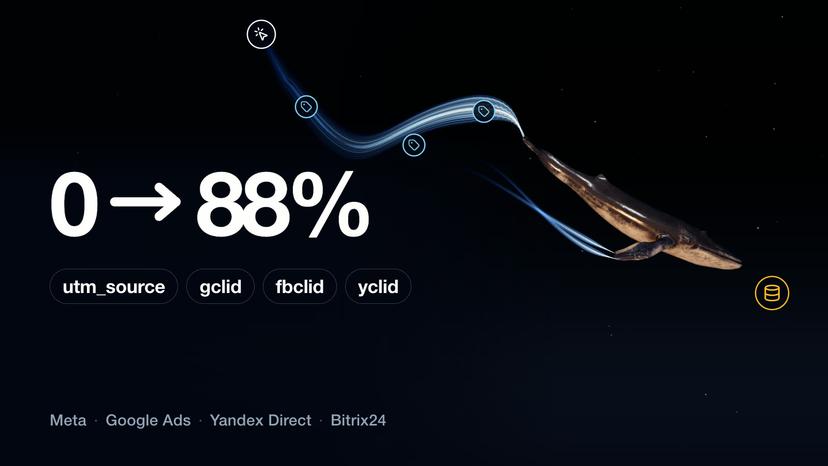
Every lead should know which ad brought it
UTM tags, click IDs and first versus last touch: how to carry the ad source from the click all the way into the CRM.
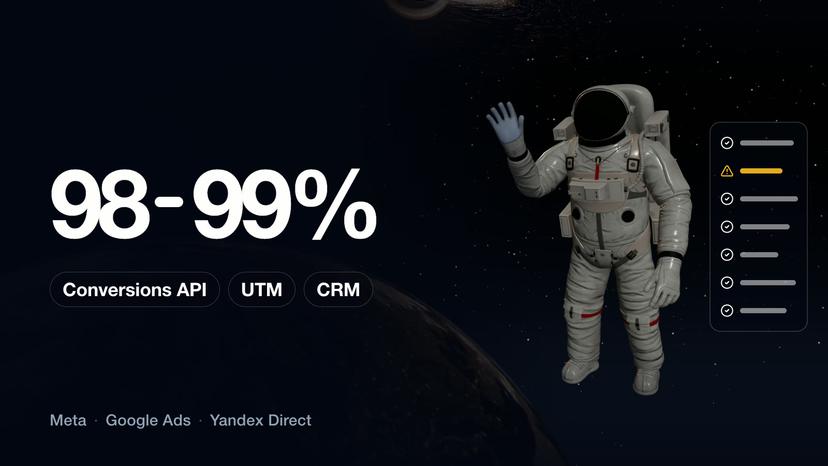
An ad tracking audit in seven checks
How to verify that conversions really reach the ad platforms and the CRM — the checks that found a silently broken Conversions API feed.